

The Hedgehog Problem
Why the Loudest Voices You're Listening To Are the Least Reliable

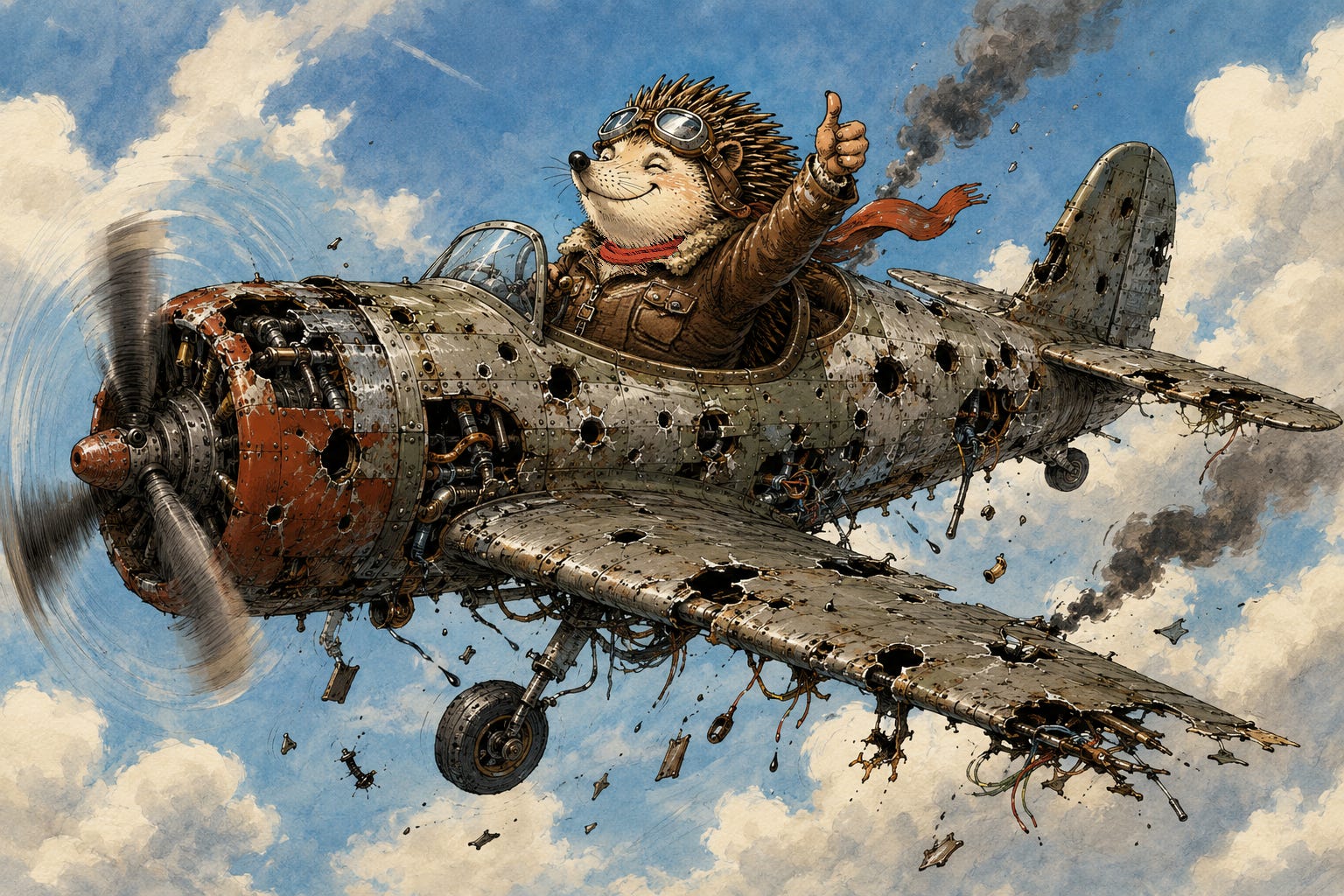
You’re at a conference. Or maybe it’s a podcast in your earbuds on the drive to work. Or a LinkedIn post someone on your team just dropped into Slack with a “this is spot on.”
A very successful person is explaining how they achieved greatness.
They’re articulate. They’re specific. They have a system with a memorable name. Maybe even a neat diagram. By the end, the path sounds so clean and so obvious that you start to feel behind.
Like everyone else already knows this.
Like the answer was sitting in plain sight and you somehow walked past it.
That feeling? It’s a damn trap.
It’s not because the person is lying. Most people telling these stories believe them completely.
But what they’re giving you usually isn’t a roadmap. It’s a revisionist rationalization connected to all the facts by only the thinnest beam of main character energy.
An outcome happened. Their brain connected the dots afterward. The lucky breaks became decisions. The dead ends disappeared. The timing looked intentional. The messy parts got compressed into a sequence that feels logical and repeatable.
Then the story gets told enough times that it starts to feel true.
And because they won, we assume they must understand why.
The reason they’re on stage isn’t that they have the best advice.
It’s that they’re still standing. That’s it.
We keep handing the microphone to whoever is most certain they know why, and mistaking their confidence for evidence.
The marketing industry has been running on this rotten fuel for decades. And it’s the reason most of us are listening to exactly the wrong people.
The Fox and the Hedgehog
The Greek poet Archilochus wrote a line about 2,500 years ago that philosopher Isaiah Berlin turned into one of the most useful ideas in modern thinking: The fox knows many things, but the hedgehog knows one big thing.
The hedgehog has a formula. A framework. A thesis that explains everything.
The fox is skeptical of grand theories. The fox holds multiple ideas in tension, tolerates contradiction, and changes course when the evidence shifts.
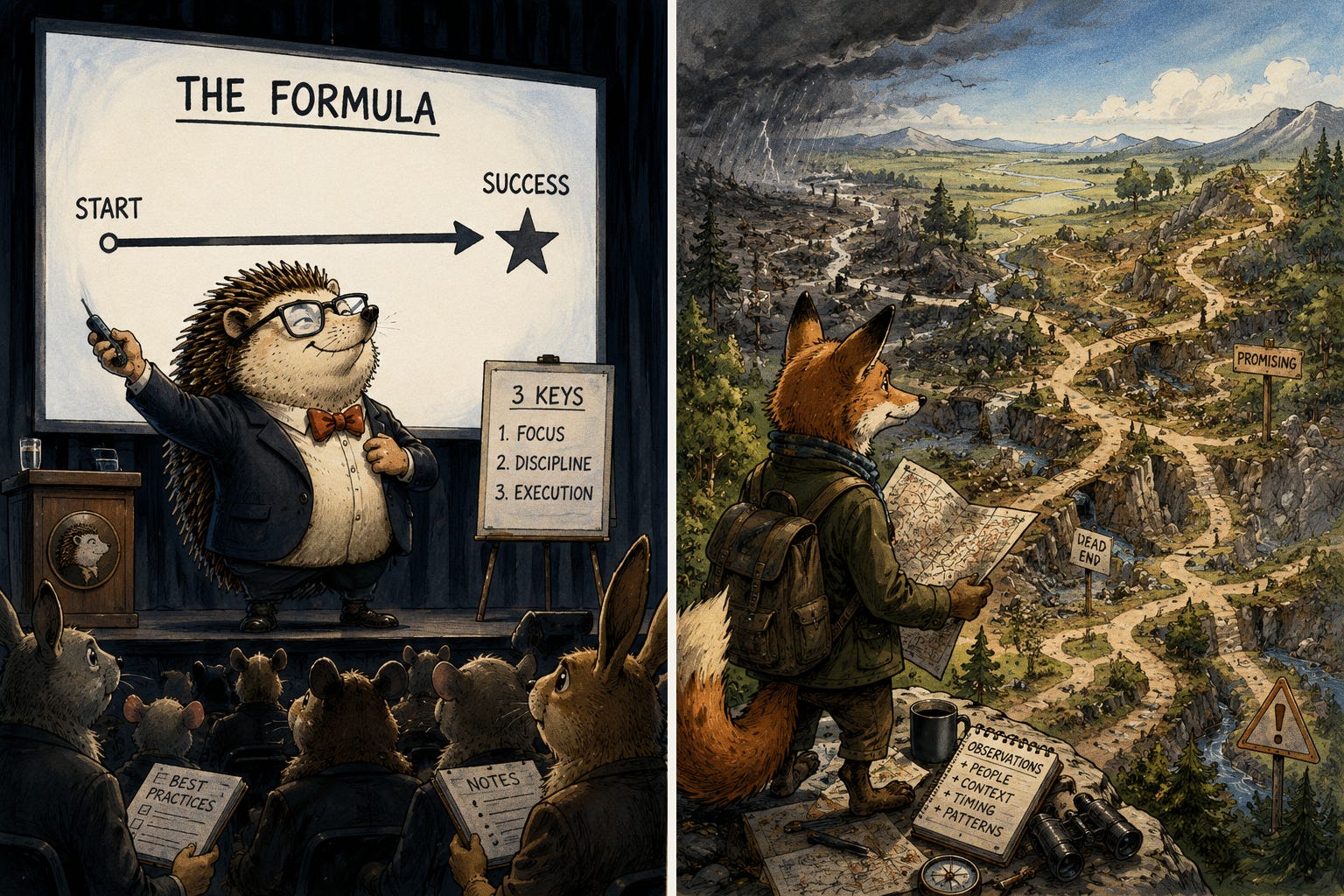
In the mid-2000s, researcher Philip Tetlock spent 20 years tracking 284 experts and over 80,000 predictions. The hedgehogs, the confident ones with big theories, were the worst predictors. Often worse than random chance. But they were the most quoted. The most booked. The most confident.
The foxes were better. Much better. But foxes make terrible podcast guests. They say things like “it depends” and “there are multiple factors” and “we can’t know for sure.” Nobody screenshots that for LinkedIn.
The marketing industry has a hedgehog problem. And it’s been costing us for decades.
The Hedgehog Parade
If you've been in marketing for more than a decade, you've lived through at least four revolutions that were each supposed to be the last one you'd ever need. Each with their own prophets, their own acronyms, their own set of “new rules of the trade”, and, ultimately, their own expiration date.
The technology changes, but the confidence doesn’t. And it doesn’t stay on stage. It migrates to our feeds.
LinkedIn has become an open mic night for hedgehogs, a place where people post slide carousels about “the one framework that changed everything” and VPs of Nothing In Particular write 800-word parables about what their Uber driver taught them about leadership.

It’s gotten so predictable that r/LinkedInLunatics, a subreddit with over 600,000 members, has become a kind of accidental anthropological experiment, cataloging the most brazen specimens of hedgehog self-promotion in real time. People know this is broken. They can smell the performance. They just keep scrolling past the lunatics and stopping on the next post that promises certainty.
In 2012 it was digital transformation. If your brand wasn’t digital-first, you were dead. In 2016 it was programmatic. Let the machines buy the media. Human judgment is the bottleneck. By 2019 it was DTC. Cut out the middleman. Build a brand on Instagram and a Shopify store. In 2024 it was generative AI. Why hire a creative team when the machine can make 10,000 ads before lunch?
Each wave came with its own confident prophets. Its own keynotes and podcasts and LinkedIn manifestos. Its own formulas. And each wave left behind a graveyard of brands that followed the formula and failed anyway, while the survivors wrote books about how the formula worked.
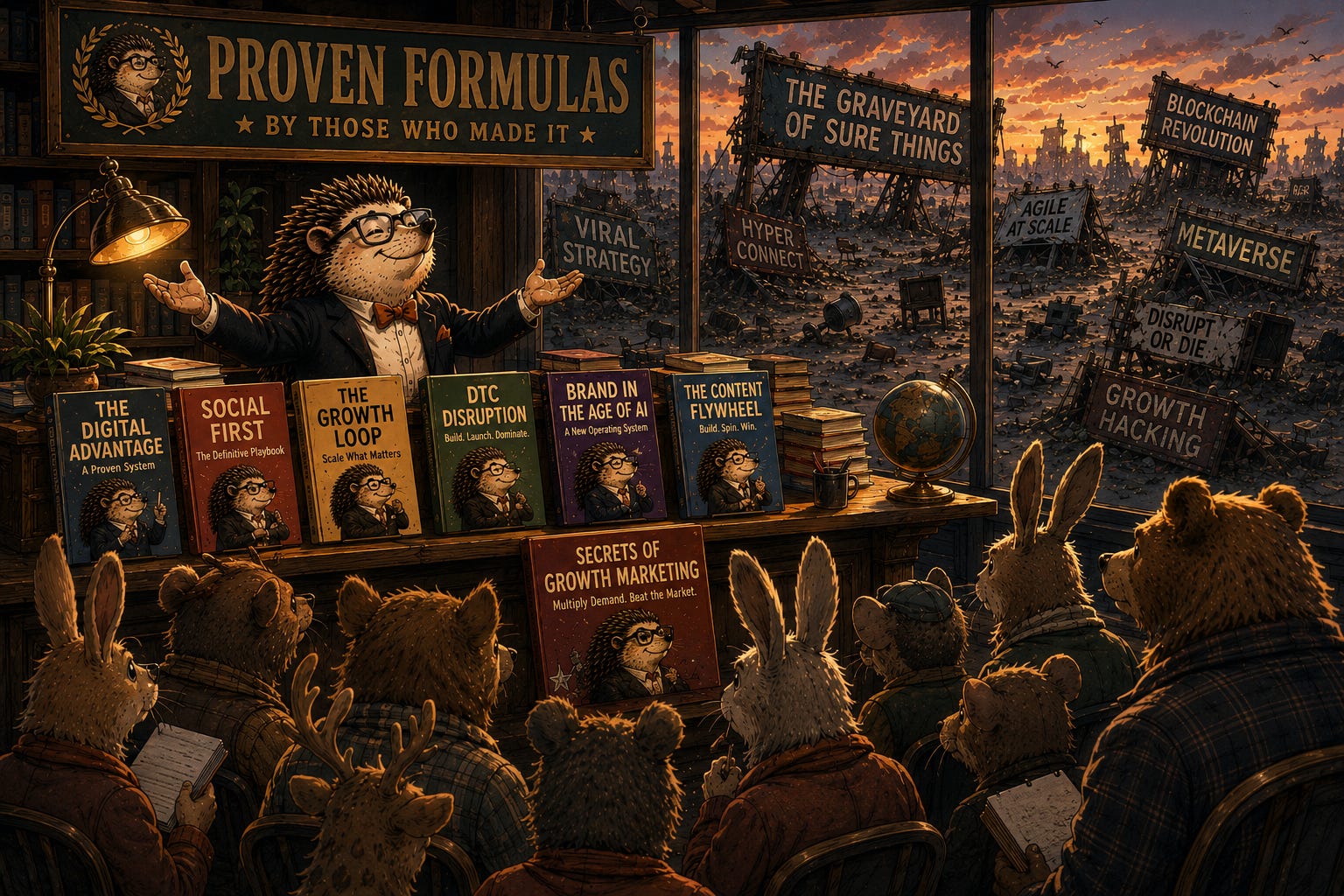
Countless CMOs and VPs of Marketing sat in those audiences, heard the hedgehog, and thought: well, it worked for them, so it must be the only way. They reorganized teams. Reallocated budgets. Killed programs that were quietly working. All because someone confident told them the future had arrived and they were behind.
The hedgehogs weren’t always wrong about the technology. They were wrong about the certainty. Digital mattered. Programmatic has a role. AI will change things. But none of them were the formula. None of them replaced the need for judgment, taste, and tolerance for ambiguity. The hedgehog just couldn’t say that, because “it depends” doesn’t sell keynotes.
The Confidence Tax
In 1999, psychologists David Dunning and Justin Kruger documented something that should be required reading for anyone who books speakers at marketing events: the less you know about something, the more confident you are that you understand it. Incompetence doesn't just make you bad at something; it makes you too bad at it to realize you're bad at it. That's the Dunning-Kruger effect.
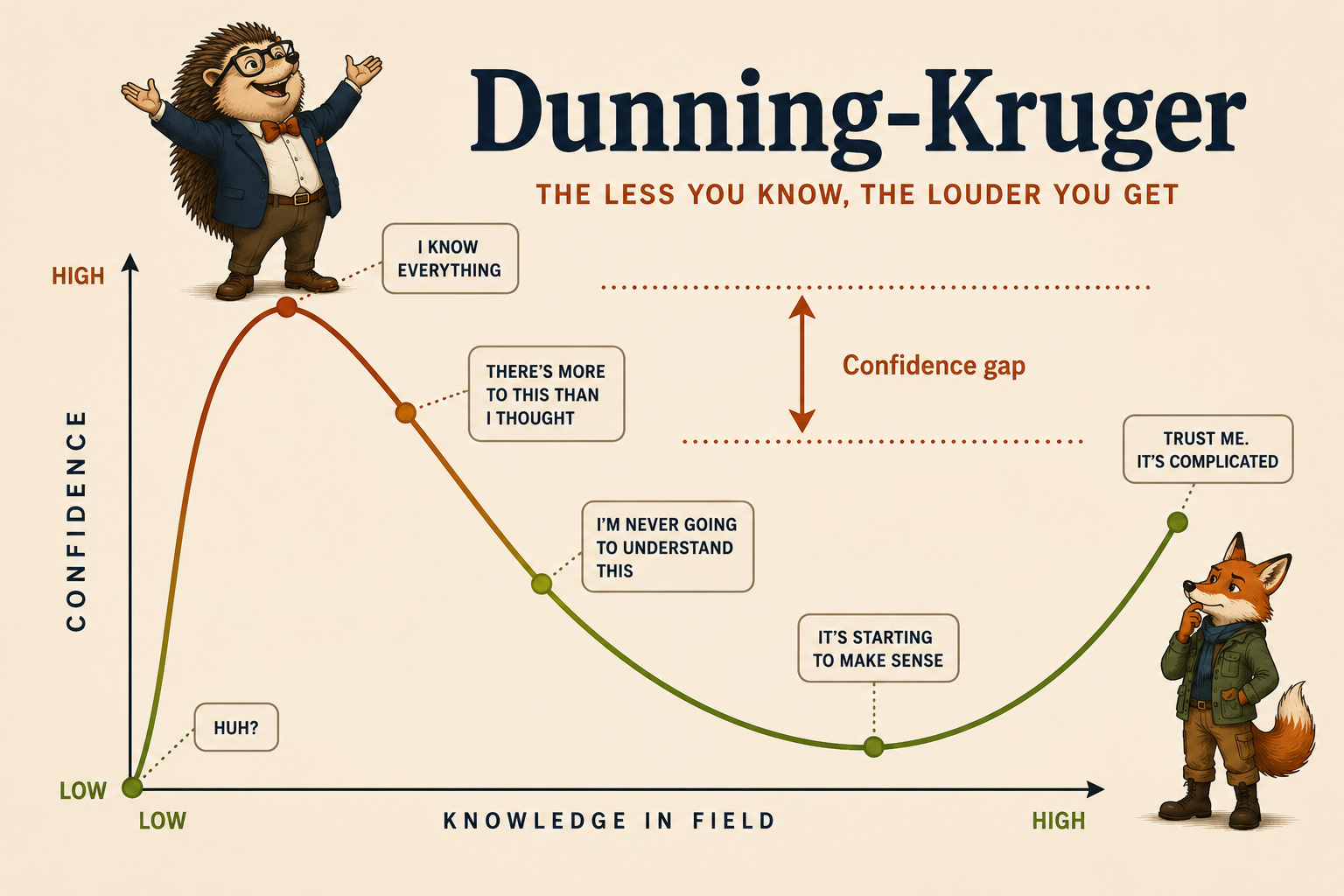
They ran experiments testing people on logical reasoning and grammar, then asked participants to estimate how well they’d done. The worst performers massively overestimated their abilities. The actual experts slightly underestimated themselves.
The implication for marketing is uncomfortable. The people most eager to tell you how technology will transform your brand, or how programmatic will solve your media problems, or how you don’t need an agency anymore, are statistically likely to be the ones who understand these things the least. The people who actually know what’s happening are too busy qualifying their statements to make a good keynote.
When you hear a speaker at Cannes say, “AI will change everything,” the question worth asking is: will there be popcorn to go with this performance?
Why We Keep Going Back
Here’s where it gets structural.
Psychologists John Jost and Mahzarin Banaji developed what they called System Justification Theory: the finding that people, even those disadvantaged by the status quo, tend to rationalize and defend existing hierarchies. We don’t just tolerate the current system. We actively construct reasons why it’s right.
Applied to marketing: once you’ve followed the hedgehog, you have a psychological investment in the hedgehog being correct. If the confident voice on stage was wrong about programmatic, then the two years you spent rebuilding your media operation around programmatic were a bet, not a strategy. If the DTC playbook was overhyped, then every brand that gutted its wholesale relationships did so on bad advice. That’s terrifying. So instead of questioning the hedgehog, we defend the system the hedgehog built.
This is how “best practices” calcify into dogma. Not because they keep working, but because admitting they’re not working means admitting we were wrong to follow them in the first place. System justification turns yesterday’s confident prediction into today’s unquestioned assumption. The hedgehogs don’t even need to keep talking. We’ll do the defending for them.
Play Poker, Not Chess
Annie Duke, the former professional poker player turned decision strategist, makes a distinction that most marketing leaders have never internalized: chess is a game of perfect information. Every piece is visible. There’s a theoretically correct move in every position. Poker is a game of incomplete information, hidden variables, and luck.
Marketing is poker. You’re making bets with imperfect data, against competitors you can’t fully see, in a market shaped by forces you can’t control. But the hedgehog tells you it’s chess. That there’s a right answer. A formula. A playbook that, if executed correctly, guarantees the outcome.
The difference matters enormously. In chess thinking, a bad outcome means you made a bad decision. In poker thinking, a bad outcome might mean you made a good decision that didn’t work out this time. The CEO who fires a CMO after one quarter of soft results is playing chess. The board that gives a brand-building strategy three years to compound is playing poker.
And most of our industry’s “proven strategies” aren’t even drawn from a representative sample. During the Second World War, the US military studied bombers returning from missions over Europe. The planes were riddled with bullet holes, clustered in the fuselage and wings. The brass said: reinforce where the holes are. A statistician named Abraham Wald said the opposite. Reinforce where the holes aren’t. The planes you’re looking at are the ones that survived. The ones that took hits in the engine or the cockpit never came home to be studied.
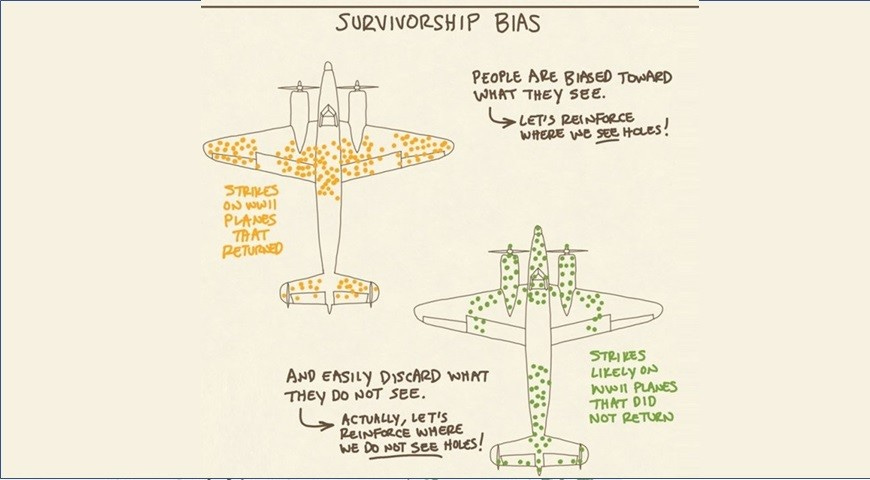
This is survivorship bias. And it’s the foundation of every marketing “best practice” ever reverse-engineered from a winner. We interview the CMO who tripled revenue. We don’t interview the 50 CMOs who ran the same playbook and got fired. We study the brand that went viral. We ignore the thousands that posted the same content into the void. The conference speaker, the podcast guest, the LinkedIn thought leader? They’re all planes that made it home. And we’re reinforcing the wrong parts.
Sociologist Duncan Watts proved this with his Music Lab experiment at Columbia. He gave over 14,000 participants access to 48 songs by unknown bands. One group rated them independently. Eight other groups could see download counts. If quality alone determined success, the same songs would have won every time.
They didn’t. One song ranked 26th in the independent group but hit number one in a social group, and number 40 in another. Quality created a floor and a ceiling. But within that range, it was randomness, social influence, and timing. The same dynamics that drive markets, brand adoption, and cultural relevance.
The formula is always a retrospective narrative. Never a forward-facing prediction. As Rory Sutherland put it: we are wrong about psychology to a far greater degree than we are about physics, so the biggest gains come from understanding perception, not optimizing mechanics.
The Cost of Hedgehog Culture
The hedgehog parade hasn’t just been wrong. It’s done real damage.
Over the past 15 years, the loudest voices in marketing have systematically devalued the things that actually drive results: better storytelling, better craft, better design, consistency over time. The quiet, hard, unglamorous work of making people feel something when they encounter your brand.
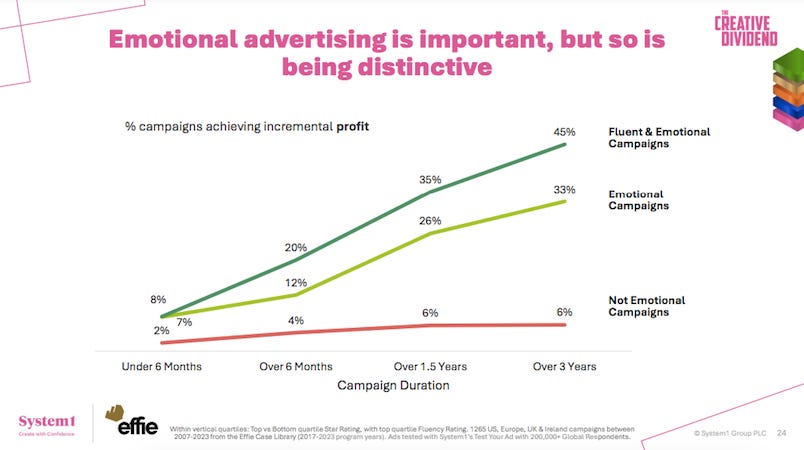
Effie and System1’s research across 1,265 campaigns is unambiguous. Campaigns with high emotional response and high distinctiveness dramatically outperform. Creative consistency over multiple years compounds brand effects. The brands that hold their positioning, keep their creative partners, and invest in showmanship over time don’t just do a little better. They do a lot better.
But those are fox answers. They’re qualified, nuanced, built on evidence that takes years to accumulate. No one gets a standing ovation at SXSW for saying “keep doing what’s working, invest in better creative, and be patient.”
Meanwhile, the hedgehogs sold a different story. One where craft is overhead. Where creative thinking is obsolete. Where the algorithm will handle it.
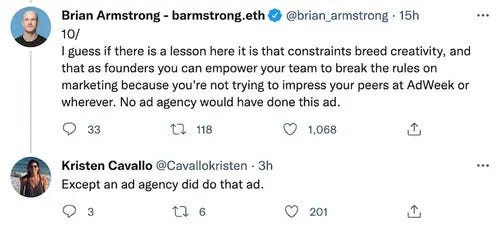
You saw it when Coinbase’s CEO publicly claimed their Super Bowl ad could never have been made by an advertising agency, as if the entire profession had its head in the sand. Then Kristen Cavallo, CEO of The Martin Agency, produced the receipts showing that her agency had, in fact, generated the concept. The hedgehog was so committed to the “we don’t need the old way” narrative that he couldn’t see what was right in front of him.

You see it with Elon Musk, who has repeatedly dismissed the value of marketing while being perhaps the most prolific self-marketer alive. He’s turned himself into more of a celebrity than a business person. He sired children with a famous musician. He raised his eyebrow at everyone at the Met Gala. He bought his own social media platform. He made himself inseparable from Tesla and SpaceX to the point where the man is the brand campaign. That’s not “no marketing.” That’s marketing so total it doesn’t recognize itself as marketing. The billionaire hedgehog who says you don’t need advertising while conducting one of the most expensive personal brand exercises in history.
The hedgehog doesn’t just give bad advice. The hedgehog makes it harder for brands to invest in the things that work, because hedgehog culture treats craft, storytelling, and creative consistency as unsophisticated. As relics. As the stuff you did before you got serious about what’s next.
The research says the opposite, but that’s fox territory.
There Is No Formula (And That’s the Good News)
So if there’s no formula, what is there?
There’s learning. As much as you can, from as many angles as you can, about your category, your customer, your culture, your competitive set. Not to find the answer, but to get better at recognizing the right bet when it shows up.
There’s consistency. Not doing the same thing forever, but holding a position long enough for it to compound. The Creative Dividend data is clear: brands that maintain creative foundations over time build stronger emotional response, stronger distinctiveness, and stronger business results. Compound creativity is real. But it requires the patience that hedgehog culture explicitly discourages.
There’s managed risk. Not recklessness, but a deliberate practice of testing ideas at the edge of what feels comfortable. The fox doesn’t avoid risk. The fox sizes it. Knows what cliff is worth jumping from and what cliff is just a cliff. Every great brand moment involved someone making a bet that couldn’t be justified by a formula. It was judgment, taste, and courage in the face of uncertainty.
And there’s readiness. Luck is real. Timing matters. Moments of chance will come. The question is whether you’ve built the brand, the team, and the instincts to recognize them and move.
None of this fits on a slide with three pillars and an acronym. And that should tell you it’s closer to the truth.
The fox doesn’t promise you a formula. The fox promises you a better way of thinking. One that tolerates ambiguity, respects evidence, stays curious, and doesn’t pretend that confidence is the same thing as competence.
The hedgehog will always be more entertaining. The hedgehog will always get the keynote. And by all means, be entertained by them.
But if you’re trying to build something that actually lasts, stop listening to the loudest voice in the room.
Start listening to the one that says: it depends.
Stay foxy, my friends👋🦊